

Independent contractors face a specific problem that salaried employees never have to think about: when someone asks for proof of income, there is no employer to call, no W-2 to hand over, and no pay stubs being automatically generated every two weeks. Whether you're applying for an apartment, a car loan, or a mortgage, you'll need to build your own documentation package from the ground up.
This guide covers what documents work, how they compare, and what you can do to make the verification process go smoothly.
Why 1099 Workers Face Extra Scrutiny
When a lender or landlord reviews a W-2 employee's application, the process is straightforward. They call the employer, confirm the salary, and move on. With a 1099 contractor, that shortcut doesn't exist.
Contractors receive 1099-NEC forms instead of W-2s, which means income is self-reported on a tax return rather than confirmed by an employer. Income also tends to be irregular — a consultant might bill $15,000 one quarter and $4,000 the next depending on project cycles. That variability isn't a sign of financial instability, but it does require more documentation to demonstrate that earnings are consistent enough to cover ongoing obligations.
The result is that 1099 workers typically need to submit more paperwork and be more proactive about organizing it.
Documents Independent Contractors Can Use
1099-NEC Forms
Any client who paid you $600 or more during the tax year is required to file a 1099-NEC with the IRS and send you a copy. These forms are official, third-party records of your income. Collecting 1099s from all your clients gives reviewers a clear, IRS-backed snapshot of what you earned across the year.
Tax Returns with Schedule C
Your federal tax return is the most comprehensive income document available to a contractor. Schedule C shows your gross revenue and itemized business expenses, and the resulting net profit is what lenders typically use to calculate your qualifying income. Most institutions ask for two years of returns to assess whether income is stable.
One thing to be aware of: deductions that reduce your tax bill also reduce your reported net income. If you write off significant business expenses, your net income may look lower than your actual cash flow.
Bank Statements
Bank statements show real money moving into your account. They're difficult to dispute and can demonstrate income patterns that your tax return alone might not convey. Most reviewers ask for three to six months of statements. Having a dedicated business bank account makes this documentation much cleaner, since there's no need to explain which deposits are business income and which are personal.
Invoices and Client Contracts
Paid invoices confirm that work was completed and payment was received. Active contracts can show future income — a signed agreement for ongoing work at a specific monthly rate tells a landlord that your income is not going to disappear next month. Together, invoices and contracts paint a picture of both your history and your pipeline.
Profit and Loss Statements
A profit and loss statement summarizes revenue, expenses, and net income over a defined period. You can generate these monthly, quarterly, or annually using accounting software. A P&L prepared by an accountant carries more weight than one you've produced yourself, though either can be useful when combined with other documentation.
CPA Letter
A letter from a certified public accountant is one of the most credible forms of income verification available to contractors. The CPA reviews your financials and confirms your income in writing. Because CPAs are licensed and legally accountable, their verification is taken seriously by most lenders and property managers.
Comparing Your Options
| Document | Pros | Cons |
|---|---|---|
| 1099-NEC Forms | IRS-verified, third-party issued, widely accepted | Only covers clients who paid $600+; issued annually |
| Tax Returns (Schedule C) | Comprehensive, universally recognized by lenders | Net income after deductions may appear lower than actual cash flow |
| Bank Statements | Hard to dispute, reflects real deposits over time | Personal and business income mix if accounts aren't separated |
| Invoices and Contracts | Shows active work and future income | Invoices don't confirm payment was received without matching bank records |
| Profit and Loss Statement | Flexible time range, shows business trends clearly | Self-prepared versions may be questioned without supporting records |
| CPA Letter | Strong third-party credibility, carries professional weight | Costs money; requires an ongoing relationship with an accountant |
How Pay Stubs Help Contractors
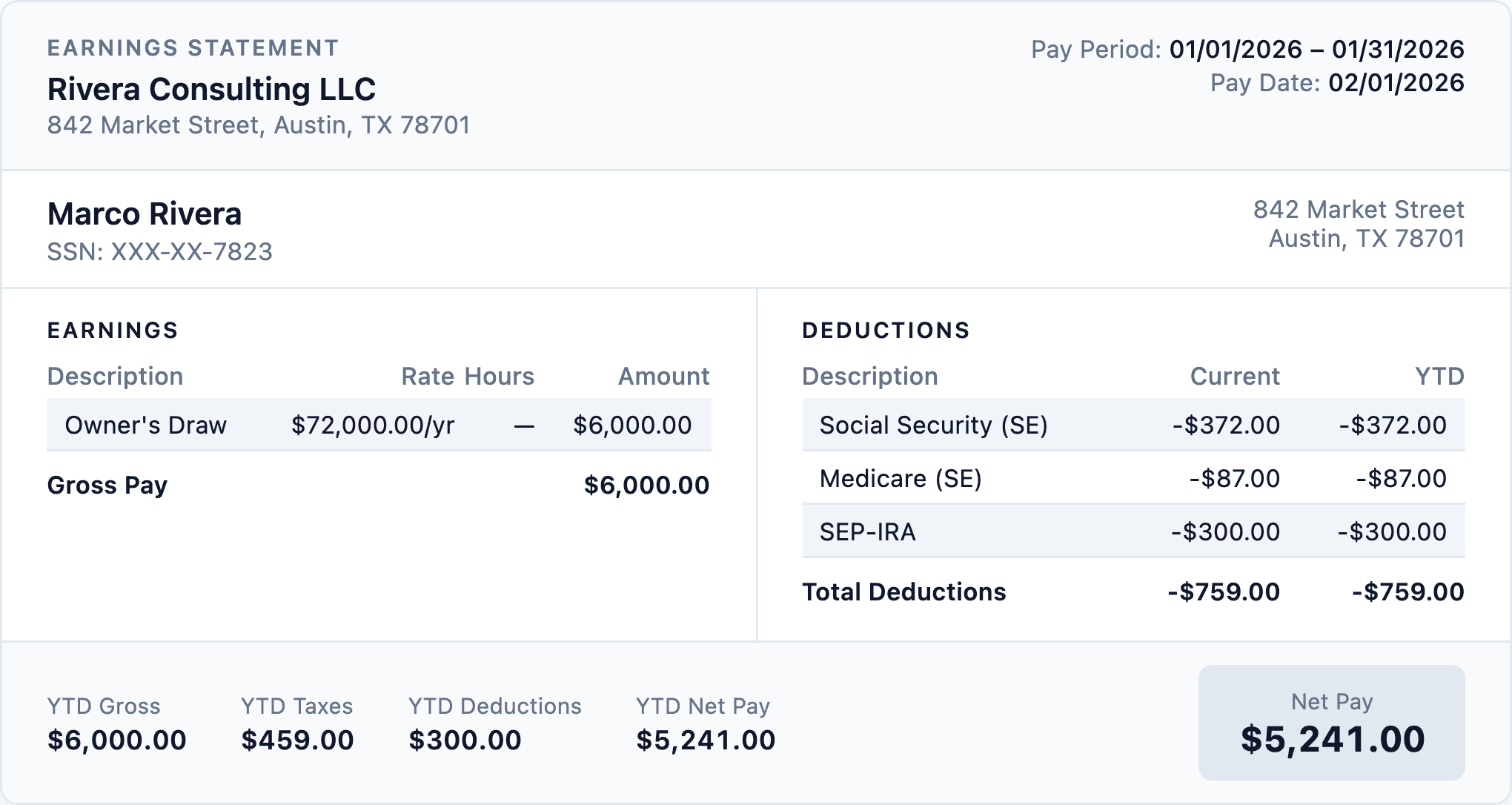
Many contractors who pay themselves on a regular schedule can use pay stubs as part of their documentation. If you transfer a consistent amount from your business account to your personal account each month, that payment can be documented as a pay stub — with your business listed as the employer and yourself as the employee.
This isn't about misrepresenting your employment status. It's about creating a standardized record of what you've actually paid yourself, in a format that reviewers are already comfortable reading. A pay stub shows the payment amount, any tax withholdings you've set aside, and the pay period — all at a glance.
Pay stubs are particularly useful for rental applications, where landlords are often looking for a simple, familiar document rather than a stack of tax forms. You can create a pay stub that reflects your contractor income in minutes, which can complement your 1099s and bank statements as part of a complete package.
For a broader look at what counts in these situations, see our guide on proof of income for self-employed workers.
Practical Tips for Contractors
Keep Records Throughout the Year
The worst time to organize your financial records is the week before an application deadline. Use accounting software to track every invoice, payment, and expense as it happens. When a lender asks for documentation, you'll be able to pull together a complete package in hours rather than days.
File Quarterly Estimated Taxes
Contractors are required to pay estimated taxes four times per year. Staying current on these payments signals financial responsibility and keeps your tax records clean. It also means you won't be scrambling to catch up when annual filing comes around.
Use a Dedicated Business Bank Account
Mixing personal and business finances makes your bank statements harder to read and easier to dismiss. A separate business account keeps your income deposits isolated and clear, which makes them far more useful as documentation.
Combine Multiple Documents
A single document is rarely enough. The strongest applications pair two or three types of proof — for example, two years of tax returns alongside six months of business bank statements and a set of current invoices. Consistency across multiple sources builds a much more convincing picture than any single document on its own.
Every document you submit should reflect your actual income. Overstating earnings on a pay stub, invoice, or financial statement can jeopardize your application and carries serious legal consequences. Your real income, documented clearly and consistently across multiple sources, is your most credible asset.