

Freelancers earn real money, but proving it to a landlord, lender, or government agency can be surprisingly complicated. Without a W-2 or employer-issued pay stubs, you have to build your own income story from multiple documents. The good news is that verifiers are increasingly familiar with freelance income — you just need to know which documents to bring.
Why Freelance Income Makes Verifiers Nervous
The core issue is variability. A salaried employee earns the same amount every two weeks, which makes their income predictable and easy to verify. Freelancers often earn project-based income that spikes in busy months and dips when projects wrap up. One month might bring in $8,000; the next might bring in $1,500.
That variability isn't a sign of instability — it's just how freelance work operates. But to a landlord reviewing your rental application or a loan officer assessing your creditworthiness, it looks riskier than a steady paycheck.
The solution is to frame your income in terms of annual averages and demonstrate the consistency beneath the fluctuation. A freelancer who earns $72,000 across twelve uneven months is in the same position as someone earning $6,000 per month on salary. Your job is to make that clear through documentation.
Documents Freelancers Can Use
There is no single document that proves freelance income the way a W-2 does for traditional employees. Instead, you build a package of supporting documents that tell a consistent story.
1099-NEC Forms
Clients who pay you $600 or more in a calendar year are required to send you a 1099-NEC. These forms are filed with the IRS, which makes them credible third-party documentation. If you have multiple clients, collecting all your 1099s shows both the total amount you earned and the diversity of your client base.
One important caveat: smaller clients who paid you less than $600 are not required to issue a 1099, even if your total earnings from them are significant. This is where other documents fill the gap.
Tax Returns and Schedule C
Your federal tax return — specifically Schedule C, which reports business income and expenses — is one of the most universally accepted proof-of-income documents. Most lenders ask for two years of returns. The downside is that Schedule C shows net income after business deductions, which may appear lower than your actual revenue. If your net income looks slim because of legitimate deductions, pair your return with a P&L statement that provides more context.
Client Contracts and Invoices
Active contracts prove future income. If you have a signed agreement showing you'll earn a specific amount per month for the next year, that document is highly persuasive for rental applications and some lenders. Paid invoices complement this by showing that clients have actually followed through on payments.
Bank Statements
Three to six months of bank statements show real cash flowing into your account. They're harder to dispute than self-prepared documents and give verifiers a direct view of your income over time. A dedicated business bank account makes this documentation much cleaner — personal and business transactions mixed together require more explanation.
Profit and Loss Statement
A P&L statement summarizes your revenue, expenses, and net income over a specific period. You can generate these monthly or quarterly using accounting software. Some lenders and landlords accept self-prepared P&Ls; others want them prepared or reviewed by a CPA.
CPA or Accountant Letter
A letter from a licensed CPA verifying your income carries significant weight because it represents professional third-party confirmation. It's especially useful when your tax return shows lower net income due to deductions but your actual earnings are higher. The letter can clarify that distinction in plain language.
Comparing Your Documentation Options
| Document | Pros | Cons |
|---|---|---|
| 1099-NEC Forms | IRS-filed, third-party verified | Annual only; misses sub-$600 clients |
| Tax Returns (Schedule C) | Universally accepted, comprehensive | Net income may appear low after deductions |
| Client Contracts | Proves ongoing and future income | Does not confirm payment was received |
| Invoices | Shows clients, rates, and payment history | Self-generated; requires supporting evidence |
| Bank Statements | Hard to dispute, shows real cash flow | Mixed personal/business deposits complicate review |
| Profit and Loss Statement | Flexible time periods, shows business health | Self-prepared versions may be questioned |
| CPA Letter | Professional third-party verification | Costs money; not all freelancers have a CPA |
How to Present Lumpy Income Convincingly
Variable monthly income is the norm for freelancers, not a red flag — but you need to frame it correctly. A few approaches that help:
Use annual averages. Instead of highlighting that your worst month was $900, show that your annual income averages $5,500 per month. A single slow month looks alarming; a 12-month average looks stable.
Show client diversity. Multiple clients signal that your income doesn't depend on one relationship. If one client disappears, you still have others. A mix of 1099s from different clients makes this concrete.
Lead with ongoing contracts. Signed contracts with recurring clients are the most forward-looking evidence of income. If you have a retainer arrangement or a long-term project, that document belongs at the top of your package.
Explain the pattern. A brief cover letter describing your work, your typical client relationships, and how your income is structured goes a long way. Verifiers are used to W-2 employees; help them understand your model.
How Pay Stubs Help Freelancers
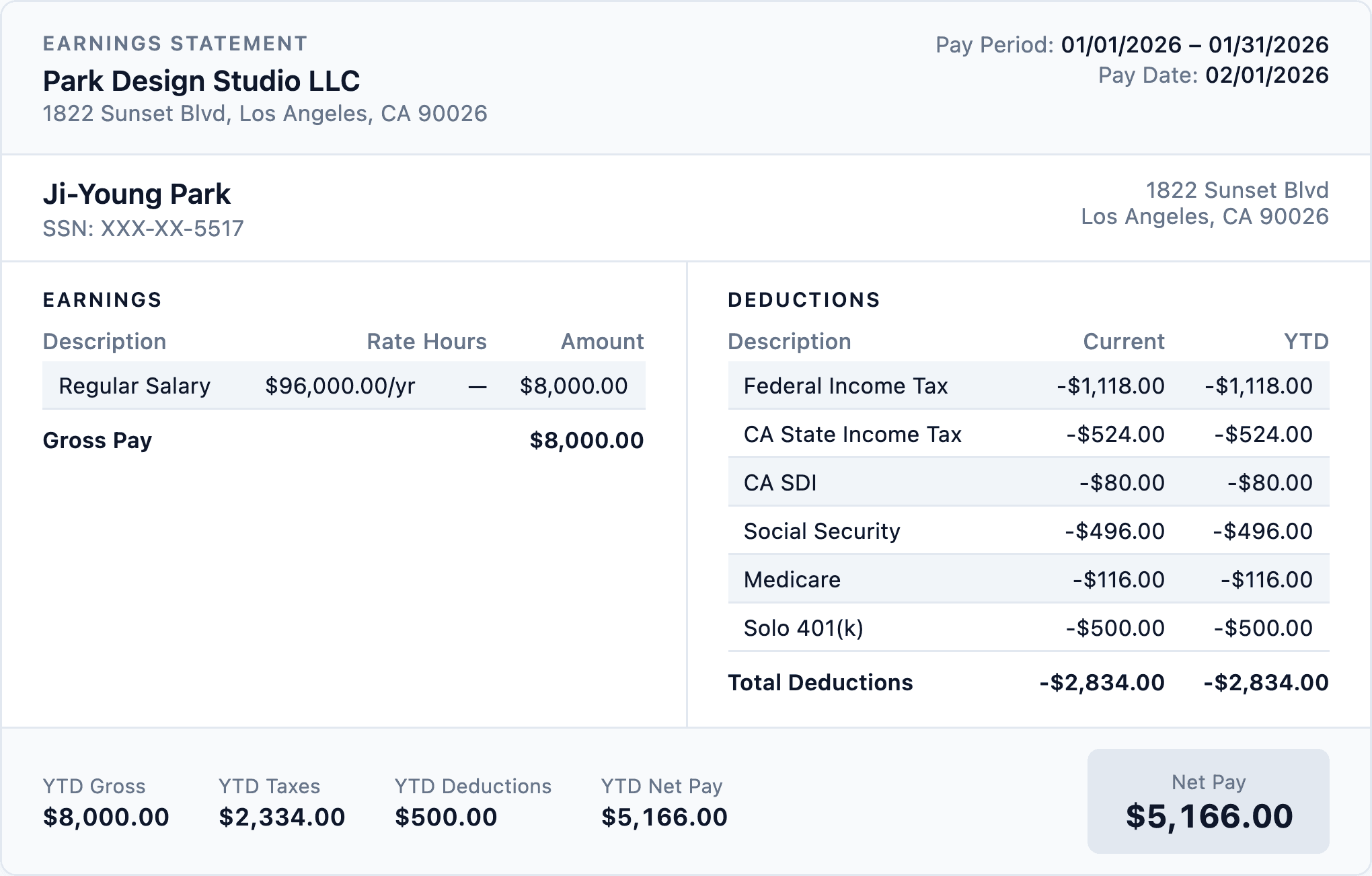
Many freelancers don't realize they can create their own pay stubs — and that those stubs can be a legitimate part of their income documentation. If you pay yourself a regular amount from your business each month, that payment can be documented with a pay stub that shows the gross amount, any estimated tax withholdings, and the net deposit.
This is especially useful for freelancers who have set up an LLC or S-Corp, but even sole proprietors who transfer a consistent amount from a business account to a personal account each month can use this approach. The key is that the pay stub should reflect actual transfers that appear in your bank statements.
Pay stubs won't replace two years of tax returns for a mortgage application, but they can be exactly what a landlord needs to approve your rental application. Many property managers are simply looking for a familiar document format, and a pay stub fits that expectation. You can create a pay stub at Paystub Studio by listing your business as the employer and yourself as the employee.
For a step-by-step guide on generating freelancer pay stubs, see how to create a paystub as a freelancer.
Practical Tips for Freelancers
Use Invoicing Software
Invoicing software creates a professional paper trail for every client payment. When you need to demonstrate income history, you can pull a complete record of all invoices sent and paid — filtered by client, date range, or project.
Keep a Separate Business Bank Account
A dedicated business account makes every deposit identifiable as business income. When a lender or landlord reviews your bank statements, clean business-only statements are far easier to understand than a personal account with mixed transactions.
Have an Accountant Prepare a Letter
If your tax return doesn't tell the full story — for example, because deductions bring your net income down significantly — a CPA letter can bridge the gap. Ask your accountant to write a letter on their letterhead confirming your gross income, business structure, and how long you've been operating.
Maintain a Client Roster
A simple document listing your current clients, the nature of your relationship, and your typical earnings from each one can help verifiers understand the breadth of your income sources. Pair it with signed contracts or recent invoices for the strongest effect.
For a broader look at what counts as proof of income across different situations, see proof of income for self-employed workers.
Every document you provide should reflect your actual income. Overstating earnings on a pay stub, invoice, or financial statement can jeopardize your application and create serious legal problems. Your real income, documented clearly and consistently, is your strongest asset.