

If you drive for Uber, deliver for DoorDash, shop for Instacart, or pick up work through any other gig platform, proving your income to a landlord, lender, or government agency is harder than it should be. You're working, you're earning, but you don't have an employer to call or a W-2 to hand over. Here's what you can use instead.
Why Gig Workers Face Income Verification Challenges
Traditional income verification was built around a simple model: one employer, one salary, one W-2 at the end of the year. Gig workers don't fit that model. Instead of a W-2, platforms send a 1099-K once you cross $5,000 in payments for the year. There's no HR department to confirm your employment status. No salary letter. No recurring pay stub sent to your inbox every two weeks.
What makes this harder is that gig income is variable by nature. A slow week in January doesn't mean a slow year. A great month in December can skew your annual total significantly. Reviewers who expect a predictable monthly number often don't know how to interpret a pattern that looks inconsistent on paper.
How to Handle Variable Income
The key to presenting gig income credibly is averaging. Rather than pointing to your best or worst month, calculate a monthly average across a full year or more. Divide your annual gross earnings by 12, and use that number when income is requested on an application.
For example, if you earned $42,000 across all gig platforms in 2025, your average monthly income is $3,500. That's the number to lead with. Back it up with your tax return or in-app earnings history to show the calculation is accurate.
When applying for something like a lease or a loan, bring at least 12 months of earnings history. The longer the period, the more convincingly it demonstrates that your income is real and sustainable.
Documents Gig Workers Can Use
There's no single document that works the same way a W-2 does, but several can be combined to build a strong case.
1099-K from the Platform
Platforms like Uber, Lyft, DoorDash, and Instacart issue 1099-K forms for payments processed through them. This is an IRS form, so it carries credibility as third-party verification of your gross earnings. The downside is that it's annual, not current, and reflects gross payments before platform fees and expenses.
In-App Earnings Reports
Most gig platforms let you export a detailed earnings history directly from the app. In the Uber Driver app, you can access weekly earnings breakdowns and annual summaries. DoorDash offers downloadable earnings statements in the dasher portal. Instacart and others have similar tools.
These reports show earnings by week or month, which is useful when you need to demonstrate consistency over time. Download them regularly rather than scrambling for historical data when you actually need it.
Bank Statements
Bank statements show the actual cash hitting your account. They're hard to dispute and don't require anything from the platform itself. Three to six months of statements, especially from a dedicated account used only for gig deposits, give a clear picture of your real take-home cash flow.
Tax Returns (Schedule C)
Your federal tax return is the most universally accepted proof of self-employment income. If you're operating as an independent contractor, you file Schedule C with your 1040 to report business profit after expenses. Two years of tax returns is a common requirement for mortgage and loan applications. Note that Schedule C reports net income after deductions, which can appear lower than your gross earnings.
Profit and Loss Statement
A profit and loss statement summarizes your total income, expenses, and net earnings over a period. You can create one yourself using a spreadsheet or accounting software. Some platforms are skeptical of self-prepared P&L statements, but pairing one with bank statements or a 1099-K adds credibility.
Pay Stubs
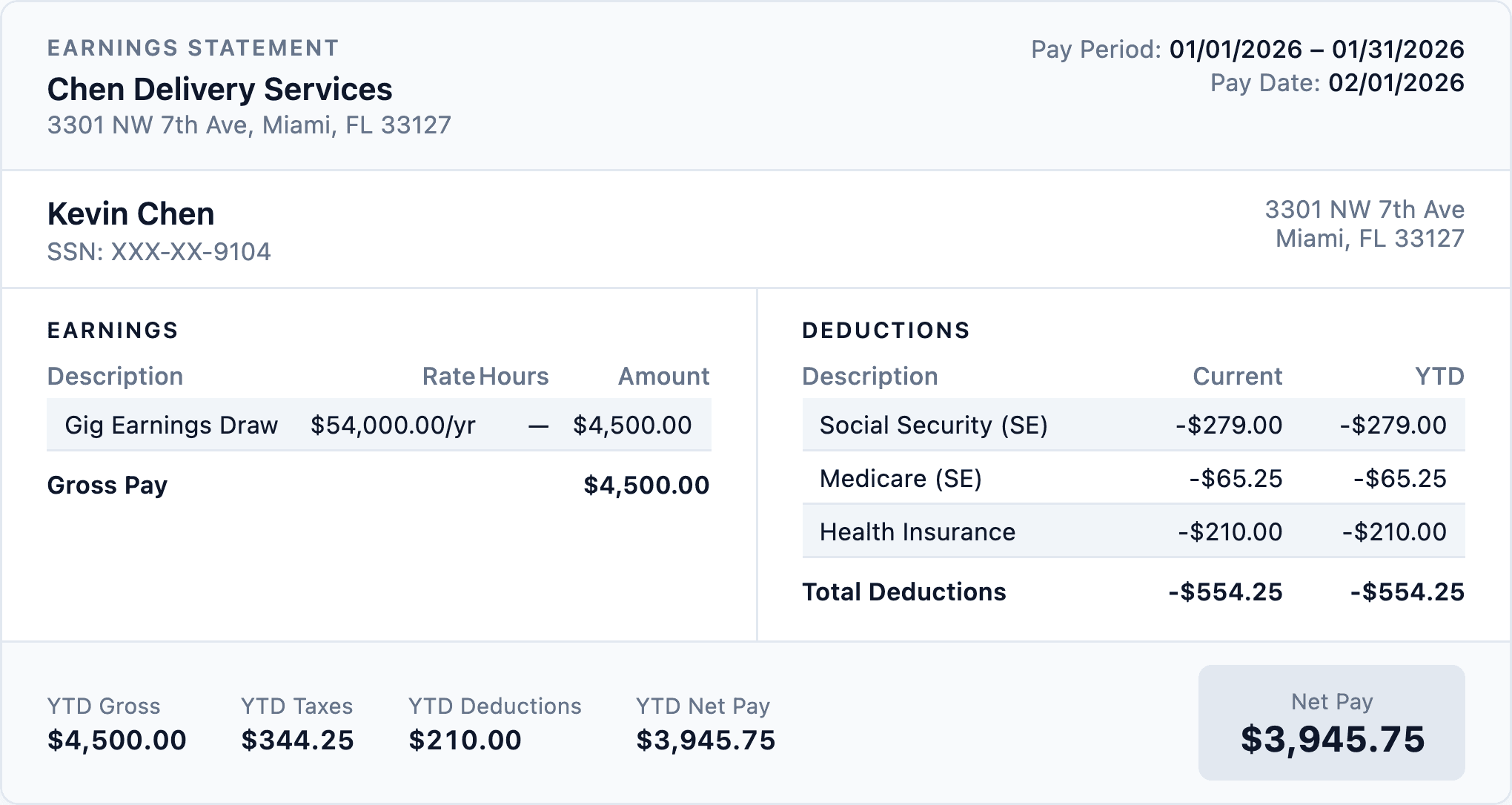
If you pay yourself a regular amount from your gig earnings, you can create pay stubs to document those payments. Treat your gig work like a business, set a consistent "salary" that you transfer to yourself each month, and generate a stub each time. Many landlords and property managers just need a familiar-looking document that shows regular income, and a pay stub fits that expectation precisely.
Comparing Document Types
| Document | Pros | Cons |
|---|---|---|
| 1099-K | IRS-issued, widely recognized as official documentation | Annual only; reflects gross before platform fees and expenses |
| In-App Earnings Report | Shows recent history by week or month; free and immediate | Not an official government document; varies by platform |
| Bank Statements | Shows real cash flow; difficult to dispute | Harder to read if personal and gig deposits are mixed |
| Tax Return (Schedule C) | Universally accepted; filed with the IRS | Shows net income after deductions, which can look lower |
| Profit & Loss Statement | Flexible date ranges; shows full income picture | Self-prepared; may require supporting documents to be credible |
| Pay Stubs | Familiar format that landlords and managers recognize immediately | Only reflects what you pay yourself, not total gig gross earnings |
Practical Tips for Gig Workers
Download Your Earnings Reports Regularly
Don't wait until you need them. Most platforms let you export earnings history, but access policies and data retention vary. Set a habit of downloading monthly or quarterly summaries and saving them to a folder you can find quickly.
Track Your Deductible Expenses
Mileage, phone bills, and equipment used for gig work are often deductible. Tracking these throughout the year reduces your tax bill and gives you a cleaner business picture when filing Schedule C. Mileage tracking apps can handle this automatically.
File and Pay Quarterly Taxes
As an independent contractor, you're responsible for paying your own taxes, including self-employment tax. The IRS expects quarterly estimated payments if you'll owe $1,000 or more for the year. Filing on time signals financial responsibility to anyone reviewing your income, and it keeps your tax returns current when you need them for an application.
Use a Separate Bank Account
If all your gig deposits go into one account used only for that purpose, bank statements become a straightforward record of earnings. Mixing personal and gig income in the same account makes your cash flow harder to read and harder to explain.
Every document you submit should reflect your actual income. Inflating your earnings on a pay stub or financial statement can put your application at risk and create serious legal exposure. Your real income, documented clearly across multiple sources, is a stronger application than an exaggerated one backed by a single document.