

Nannies, housekeepers, caregivers, and other household workers face a problem that most employees never think about: their income is often hard to prove. Many are paid in cash, work for a private family rather than a company, and receive no formal pay documentation at all. When it comes time to apply for an apartment, take out a loan, or qualify for any service that requires proof of income, that informality becomes a real obstacle.
This guide covers what documents work, how to get them, and what to do when your employer hasn't been issuing paystubs.
Why Household Worker Income Is Hard to Verify
Most employers issue paystubs automatically through payroll software. Household employers — the families who hire nannies and cleaners — often don't. They may pay by cash, check, or Venmo and keep no formal records. Some are unaware of the "nanny tax" rules that apply once wages exceed $2,700 per year. Others know the rules but ignore them.
This creates a gap for workers. Even if your income is steady and substantial, you may have nothing official to show for it. Verifiers like landlords, lenders, and government agencies aren't trying to make your life difficult — they simply need documentation they can rely on.
The informal nature of household employment also means some workers are paid partly or fully off the books. While that may be convenient in the short term, it creates a significant paper trail problem. If your employer hasn't withheld taxes or filed the right forms, your options for documentation are narrower.
Documents That Work for Income Verification
Paystubs
Paystubs are the clearest and most universally accepted form of income verification. If your employer provides them, gather your two or three most recent stubs. They should show your name, your employer's name, pay dates, gross pay, any deductions, and net pay.
If your employer has not been issuing paystubs, that's fixable. Many families simply haven't set up a payroll process and will provide documentation if asked. You can also generate accurate paystubs yourself using a tool like Paystub Studio — just enter your pay rate, hours, and pay period details.
Employment Letter from the Family
A written letter from your employer is one of the most practical options for household workers. The letter should be signed by the employer and include your name, your role, your hourly rate or weekly salary, the number of hours you work, how long you've been employed, and contact information for the employer.
This doesn't need to be formal or elaborate — a clear, signed statement on plain paper carries weight with most landlords and lenders, especially when paired with bank records.
Bank Statements
Bank statements showing regular deposits that match your claimed income are strong supporting evidence. Most verifiers ask for two or three months of recent statements. Consistent deposit amounts on a predictable schedule — every Friday, for example — make it easy for a reviewer to see a clear income pattern.
This works best when payments arrive via check or direct transfer rather than cash. If you're paid in cash, consider depositing it regularly and keeping a consistent schedule of deposits.
Tax Returns and Schedule H
If your employer has been complying with the nanny tax rules, they file a Schedule H (Household Employment Taxes) with their personal tax return each year. This is an official IRS record that documents wages paid to you. You can use your own tax return as income proof, particularly if you've filed and reported your household employment income.
Tax returns give verifiers a picture of your full-year earnings rather than a single pay period. For income that varies — seasonal hours, multiple employers — a return is often more useful than paystubs alone.
W-2
If your employer withholds taxes from your pay, they are required to issue you a W-2 by January 31 each year. A W-2 shows your total wages and tax withholdings for the prior year and is one of the most trusted forms of income documentation. If you've received W-2s in prior years, keep them — they're reliable proof of past earnings.
Document Comparison
| Document | Pros | Cons |
|---|---|---|
| Paystubs | Widely accepted, shows current income clearly | Many household employers don't issue them |
| Employment Letter | Easy to obtain, personalizes the arrangement | Not always accepted on its own; may need to be paired with other docs |
| Bank Statements | Shows real income deposits; widely available | Cash payments don't appear; requires regular depositing habits |
| Tax Return | Official; shows full-year income; useful for variable hours | Only covers prior year; not useful if income wasn't reported |
| W-2 | High credibility; issued by employer; matches IRS records | Only available if employer withheld taxes; covers prior year only |
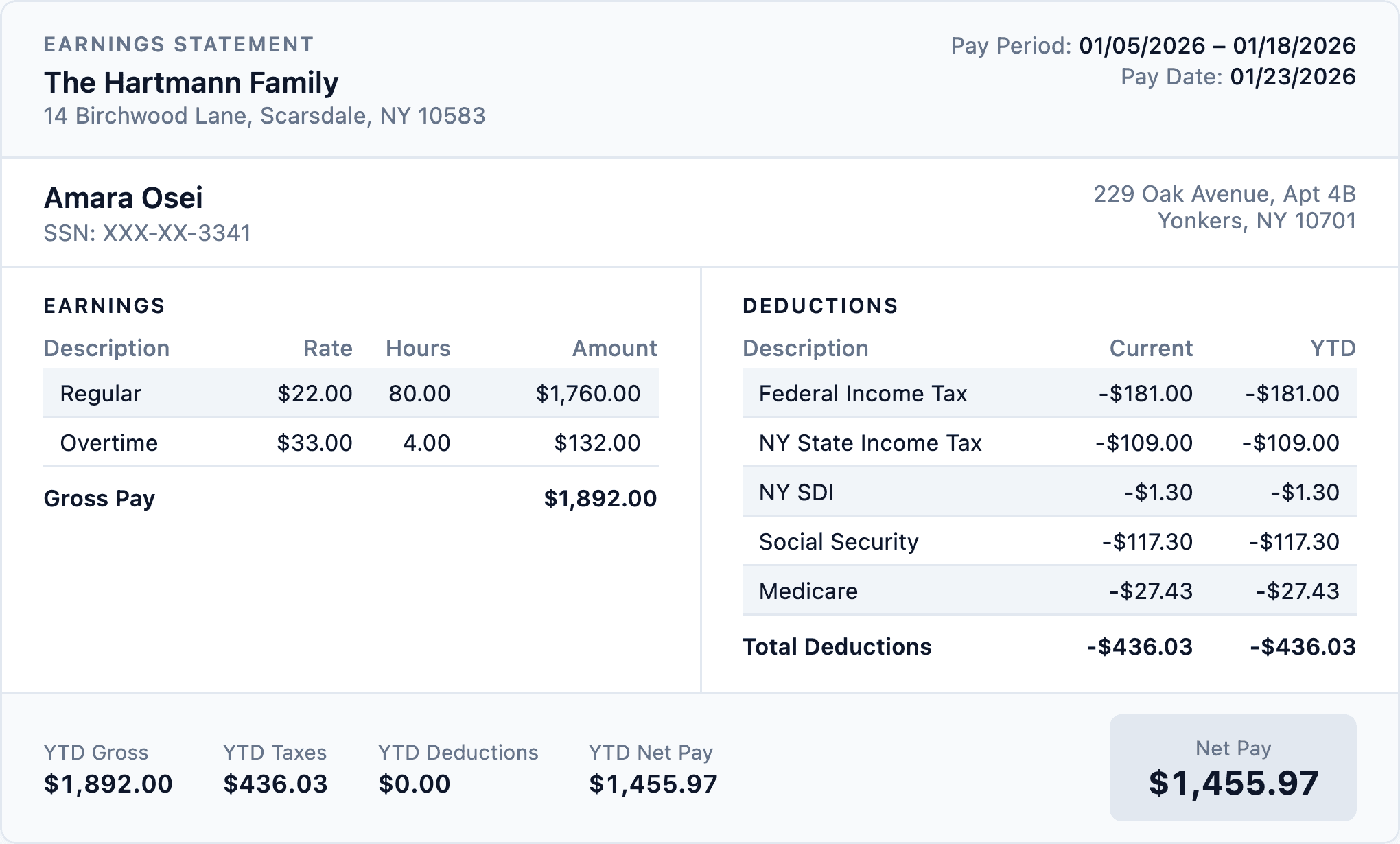
How to Get a Paystub When Your Employer Doesn't Provide One
The most direct path is to ask your employer. Many families simply haven't thought about it. Explain that you need pay documentation for an application and ask if they'd be willing to provide a written summary of your wages and hours. Most will agree.
If your employer won't or can't create paystubs, you can create your own. A self-generated paystub is legitimate as long as the numbers are accurate and reflect what you actually earn. Tools like Paystub Studio let you enter your employment details and generate a clean, professional document. Be prepared to back it up with bank statements that show matching deposits — verifiers may ask for both.
For a related walkthrough specific to employers, see how to create a paystub for a nanny.
Practical Tips for Household Workers
Ask Your Employer to Put the Arrangement in Writing
A simple signed letter documenting your pay rate, schedule, and start date protects both of you. It doesn't require a lawyer or a formal contract. A one-page summary signed by your employer can make a significant difference when you need to prove your income.
Keep a Consistent Deposit Record
If you're paid in cash, deposit it into your bank account regularly. Consistent, documented deposits create the paper trail that bank statements need to serve as proof of income. Irregular depositing makes it harder for reviewers to interpret your statements.
File Your Taxes Correctly
Household employment income is taxable. If your employer reports wages on a Schedule H and issues a W-2, your taxes are handled in the formal process. If they don't, you may still owe self-employment taxes and should report your income on your return. Filing correctly means your tax return becomes usable documentation — and avoids problems down the road.
Know What Verifiers Actually Need
Different verifiers have different requirements. Landlords often want proof of income covering two to three months of income. Lenders reviewing a loan application may want a full year. Understanding what's being asked for helps you prepare the right combination of documents rather than guessing.
All income documentation you provide should accurately reflect what you actually earn. Inflating wages or misrepresenting your employment situation — even on a self-generated paystub — can have serious consequences, including application denial, contract termination, or legal liability. Accurate records protect you as much as they satisfy a verifier's requirements.