

Part-time workers face a trickier income verification process than full-time salaried employees. Variable hours make it harder to show a stable, predictable income. Lower totals may fall short of lender or landlord thresholds. And if you're working two or three part-time jobs at once, documenting all of it without clear paystubs from each employer gets complicated fast.
None of these problems are insurmountable, but they do require preparation and the right documentation.
Why Verifiers Scrutinize Part-Time Income
When a landlord or lender evaluates your income, they're looking for two things: how much you earn and how reliably you earn it. Full-time salaried workers are easy to evaluate because both answers are consistent week to week.
Part-time hourly income introduces uncertainty. Your hours might vary based on the season, your employer's scheduling needs, or your own availability. That variability is exactly what verifiers are trying to account for, which is why they often ask for more documentation from part-time workers than they would from a salaried employee.
Expect to provide two or three months of paystubs rather than just one. Verifiers use multiple pay periods to identify a pattern. If your hours fluctuate week to week, a longer history helps them calculate a realistic average.
Documents That Work for Part-Time Income
Paystubs
Paystubs are the most direct proof of what you've actually been paid. For part-time income, aim to provide your two or three most recent stubs. Verifiers will look at gross pay, hours worked, and whether your income is consistent. If your hours vary, more stubs give a better average.
W-2 Forms
A W-2 from your employer summarizes your total wages for the prior tax year. It's useful as a baseline, but it won't reflect any changes in your hours or pay rate since the previous year. Use it alongside current paystubs rather than as a standalone document.
Offer Letter
If you recently started a job or changed positions, an offer letter from your employer stating your hourly rate and scheduled hours helps fill the gap when you don't yet have many paystubs. The letter should be on company letterhead and signed by your employer or HR.
Bank Statements
Two to three months of bank statements showing consistent deposits from your employer can reinforce your paystubs. This is especially useful when you're combining income from multiple sources, since it gives verifiers a consolidated view of your actual cash flow.
Tax Returns
Your most recent federal tax return shows total annual income across all sources. For part-time workers with multiple jobs, this is often the clearest single document to demonstrate combined earnings. Be aware that returns only reflect the prior year and may not capture a recent pay raise or new job.
Document Comparison
| Document | Pros | Cons |
|---|---|---|
| Paystubs | Shows current pay, hours, and employer name in one place | Variable hours make a single stub less convincing |
| W-2 Form | Widely recognized, shows full-year earnings per employer | Reflects prior year only, not current hours or rate |
| Offer Letter | Useful for new jobs with limited pay history | Doesn't confirm actual hours worked or pay received |
| Bank Statements | Shows real deposits across multiple income sources | Requires explanation of each deposit; takes time to review |
| Tax Returns | Combines all income sources in one official document | Only covers prior year; complex to parse for verifiers |
Combining Income from Multiple Part-Time Jobs
Many part-time workers earn income from two or more employers simultaneously. Verifiers can count this combined income, but you need to document each source separately.
For each employer, gather your most recent paystubs and, if available, a W-2. If one job is recent and you don't have a W-2 yet, an offer letter plus a few paystubs from that employer will work. When you submit your application, label each set of documents clearly so the verifier can see where each piece of income comes from.
Your most recent tax return, if it reflects all your current jobs, can serve as a useful summary document on top of the per-employer paystubs.
Estimating Annual Income from Variable Hours
Part-time hourly work doesn't come with a salary figure you can point to directly. When a verifier asks for your annual income, you'll need to calculate it yourself based on your recent earnings history.
Add up your gross pay across the last 12 weeks of paystubs. Divide by 12 to get your average monthly gross income. Multiply by 12 to project an annual figure. This approach gives a reasonable estimate that's grounded in actual earnings rather than a theoretical maximum based on your hourly rate and scheduled hours.
Be honest about variability. If your hours have dropped recently, use the lower numbers. Overstating income on an application can be considered fraud, and a verifier who checks your bank statements or calls your employer will catch it.
When Your Employer Doesn't Provide Detailed Paystubs
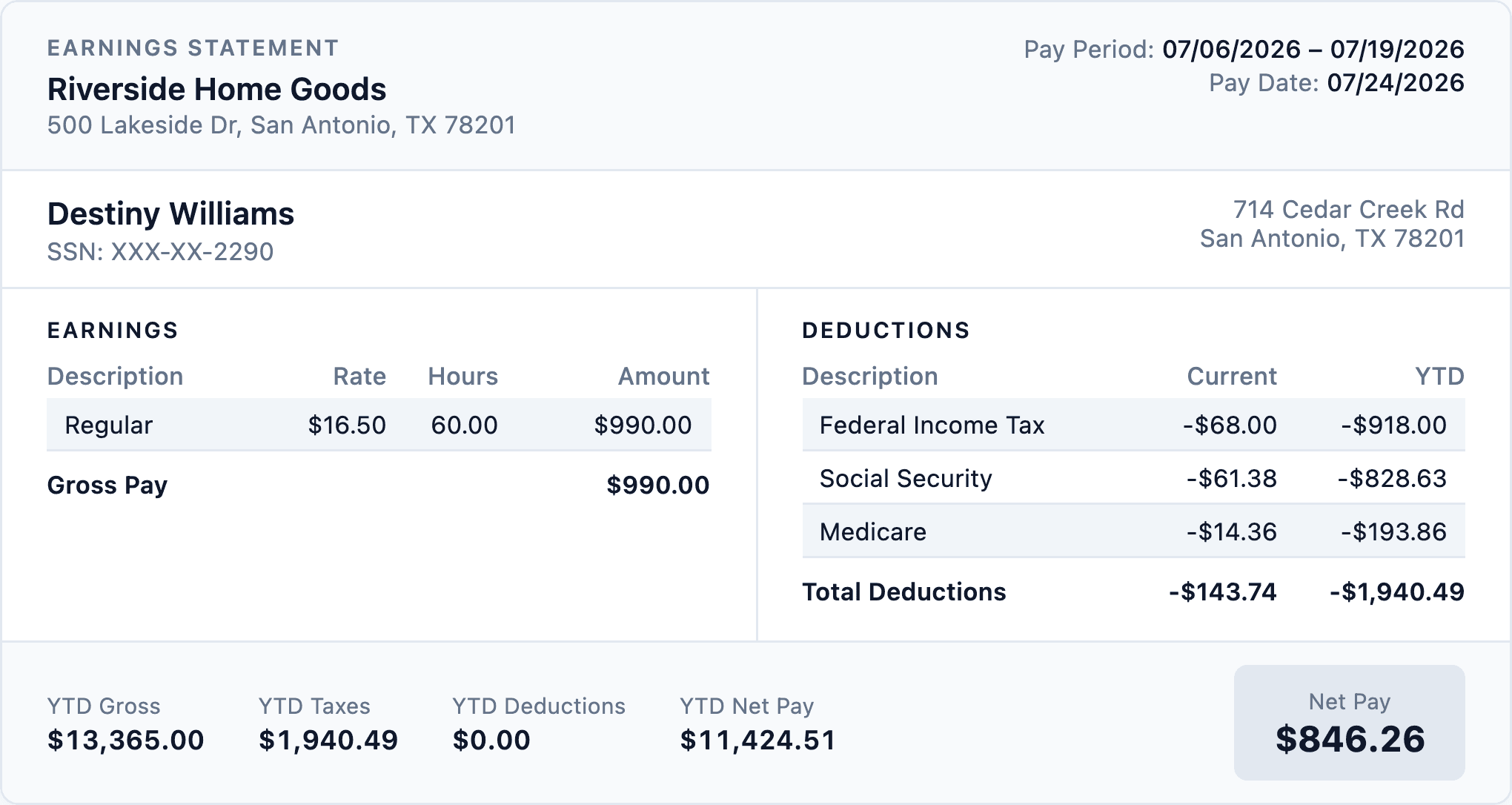
Some part-time employers, particularly small businesses, pay by check or direct deposit without issuing formal paystubs. This creates a real documentation problem when you need to apply for an apartment or a loan.
In these cases, you can create your own paystubs that reflect your actual earnings. Enter your hourly rate, hours worked each pay period, and employer information to generate a clean, professional pay statement. Pair these with your bank statements to show that the deposits match the stubs.
This approach is also useful if your employer's paystubs are minimal and don't include the line-by-line detail verifiers expect to see. For more on what makes a paystub credible, see our guide on what counts as proof of income.
Practical Tips for Part-Time Workers
Keep Every Paystub
Save every paystub you receive, whether it arrives on paper or by email. A longer earnings history is almost always more useful than a shorter one when your hours fluctuate.
Document All Income Sources
Don't leave any employer off your application. Even a small amount of additional income can move you above a threshold, and hiding it looks worse than including it. Bring paystubs or offer letters for every job you hold.
Be Honest About Variable Hours
If your hours change week to week, say so. Some verifiers will appreciate a short written explanation of how your scheduling works, particularly if you can show that your average earnings over time are consistent.
Ask Your Employer for a Letter
A letter from your employer on company letterhead confirming your average weekly hours and hourly rate carries real weight, especially if your paystubs alone don't tell a clear story. Most managers will write one if asked directly.
For more on the documents landlords accept, see our guide on proof of income for renting.
Accuracy matters more than anything else in income verification. Use your real earnings history, document every source, and don't inflate your numbers. Verifiers cross-check paystubs against bank deposits and tax records, and inconsistencies create delays or rejections that accurate documents would have avoided entirely.